Introduction – Why Read the Global Risks Report Through a Fragility Lens?
The World Economic Forum’s Global Risks Report 2026 (GRR) sets out the forces shaping today’s uncertainty: climate stress, geopolitical fragmentation, technological acceleration, and social instability.
Rather than revisiting the report’s rankings or categories, I’ve looked at what emerges when it is read through a fragility lens. That means shifting attention away from threats themselves and toward how dependencies interact, and how exposure accumulates within services and systems.
Risk frameworks typically ask: What might happen, and how severe would it be?
A fragility lens asks a different question: Where are systems already close to their limits when pressure arrives? In practice, I’ve found organisations are usually better at listing threats than at recognising how little margin they have left when several occur together.
This shift matters because disruption rarely arises from a single cause. It emerges from the interaction of multiple stresses acting on tightly coupled dependencies – technical, organisational, and external. The GRR implicitly describes this condition, but its structure remains organised around categories of risk rather than patterns of exposure.
Reading the report this way isn’t about challenging its conclusions. It’s about asking what they imply for systems already operating with thin margins.
From Risk Categories to Dependency Exposure
The GRR groups threats into familiar domains: environmental, geopolitical, technological, economic, and societal. This classification is useful for describing the external risk landscape. However, services do not fail along category boundaries. They fail through dependencies.
A service becomes fragile not because a particular risk exists, but because it relies on interacting components – people, technology, data, third parties, physical locations, and governance processes – that must continue to function under stress. When these dependencies are tightly coupled, disruption in one domain can propagate rapidly into others.
A fragility lens therefore shifts attention away from individual hazards and toward the structure of the system itself. It asks:
Which dependency domains are repeatedly stressed by different risks?
Where do multiple risk signals converge on the same underlying dependencies?
How much adaptive margin remains when several pressures occur together?
Risk categories describe what may happen. Exposure shows where that pressure will land.
This distinction becomes especially clear in the GRR, which repeatedly highlights cascading and compounding effects. Climate events disrupt supply chains. Cyber incidents undermine trust in institutions. Misinformation amplifies political instability. These are not separate risks so much as expressions of interaction across shared dependency layers.
A dependency-based reading allows the report to be interpreted as a map of structural strain rather than a list of threats.
Mapping Global Risk Signals onto Fragility Domains
When the major themes of the GRR 2026 are examined through dependency domains, clear patterns begin to emerge. Rather than distributing evenly across systems, risk signals concentrate around a small number of highly stressed dependency clusters.
Technology and Data Dependencies
Cyber insecurity, AI misuse, and misinformation appear throughout the report as distinct risk categories. Viewed through a fragility lens, they form a single interacting dependency cluster: digital systems coupled with human trust and decision authority.
Fragility here rarely comes from a single technical failure. It shows up when automation, speed and governance start moving at different paces.
This creates a condition in which complexity grows faster than oversight, and where small disturbances can have disproportionate effects.
Third-Party and Ecosystem Dependencies
Geoeconomic confrontation, supply chain disruption, and resource insecurity all point toward concentrated external dependency exposure. Many services rely on ecosystems that offer limited substitution and little visibility into their own fragility.
From a dependency perspective, the issue is not simply disruption, but the absence of adaptive margin when disruption occurs. Individually resilient organisations may remain collectively fragile if they depend on the same constrained suppliers, data providers, or infrastructure.
The report’s emphasis on fragmentation and reduced global cooperation reinforces this signal: substitution is becoming harder precisely when it is most needed.
Governance and Decision Systems
Political polarisation, misinformation, and institutional trust erosion reveal a less tangible but equally critical dependency domain: decision-making under uncertainty.
Governance fragility doesn’t look like a system outage. It looks like hesitation, misalignment and slow decisions when assumptions stop holding.
This domain amplifies the effects of other disruptions by shaping how quickly and coherently systems can adapt.
A Conceptual Mapping of Global Risk to Dependency Exposure
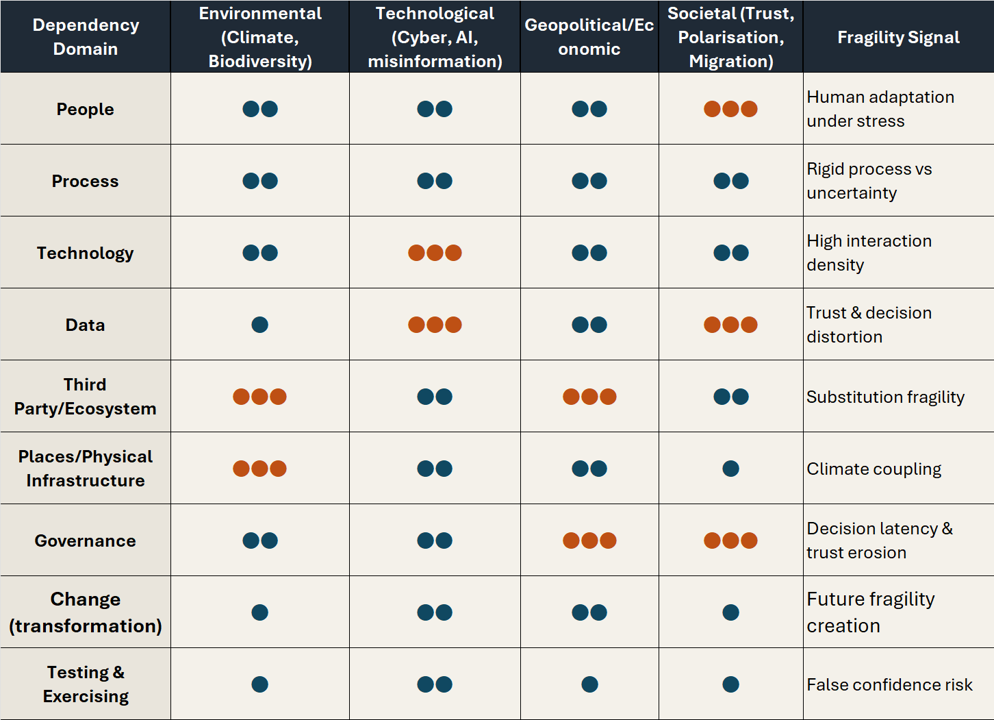
The table below is conceptual and illustrative. It isn’t a scoring model or a quantitative assessment.. The symbols indicate relative interaction density and adaptive margin based on thematic clustering in the GRR when interpreted through a fragility lens, rather than likelihood or impact. Its purpose is to highlight where dependency exposure appears most concentrated, not to prescribe priorities. It is intentionally imperfect. The point is not precision, but visibility of clustering.
(Illustrative Fragility View)
Legend:
●●● = High interaction density / constrained adaptive margin
●● = Moderate interaction density
● = Lower interaction density
Where Fragility Concentrates – A Diagnostic View
Across these domains, a clear pattern emerges. Fragility does not distribute evenly across systems. It concentrates in areas where multiple risk signals converge on the same underlying dependencies and where interaction effects reduce the system’s capacity to adapt.
Three concentration zones stand out: technology and digital infrastructure, third-party ecosystems, and governance and decision systems.
Technology and Digital Infrastructure – High Interaction Fragility
Digital systems are increasingly fast, automated, and interconnected, while governance and human oversight evolve more slowly. The result is not simply technical vulnerability, but a narrowing margin for error when disturbances occur.
Fragility arises from coupling automation with incomplete understanding, speed with limited verification, and global reach with local control. In such conditions, small deviations can propagate rapidly across services that depend on the same digital backbone.
Third-Party and Ecosystem Dependencies – Substitution Fragility
Many services are embedded within dense networks of suppliers, cloud providers, data platforms, and infrastructure operators. Individually, these components may appear resilient. Collectively, they form systems with shared points of strain and constrained alternatives.
Fragility in this domain is shaped less by the probability of disruption than by the system’s ability to reconfigure when disruption occurs. Where substitution is difficult, recovery becomes dependent on conditions outside organisational control.
The report’s observation of declining international cooperation reinforces this signal: the more fragmented the environment becomes, the less viable substitution and mutual support are likely to be when they are most needed.
Governance and Decision Systems – Latent Fragility
Governance fragility appears not as immediate failure, but as hesitation, misalignment, and erosion of shared understanding. In several incidents I’ve observed, the technology function recovered quickly. What slowed the organisation was uncertainty over who should decide, and on what information. Under compound stress, these effects amplify other disruptions by slowing response and increasing uncertainty.
Where authority is unclear or information is contested, the system’s ability to adapt weakens even if technical and operational capabilities remain intact. This domain is often invisible in resilience assessments because it does not belong to a single function or control set, yet it determines whether other dependencies can be coordinated when assumptions no longer hold.
Cumulative Exposure and Margin Erosion
Across these concentration zones, fragility arises not from isolated weaknesses but from cumulative exposure across interacting domains.
Technology, third-party ecosystems, and governance systems do not operate independently. They intersect. A cyber incident may depend on external providers. A supply disruption may require rapid governance decisions. A misinformation campaign may distort technical response.
Each interaction consumes adaptive margin. Margin rarely disappears in one dramatic step. It thins quietly.
Over time, systems may appear stable while their tolerance for surprise quietly diminishes. This creates a condition in which disruption feels more frequent not because hazards are entirely new, but because systems are less able to absorb deviation.
From a diagnostic perspective, this suggests a shift from episodic risk toward structural fragility – where resilience is challenged not by extraordinary events, but by ordinary stresses occurring together.
A Different Question
The GRR invites readers to ask which threats matter most. A fragility lens reframes the question:
The question shifts. Instead of asking which risks are highest, the focus moves to where systems have the least room to manoeuvre.
This distinction directs attention away from prediction and toward exposure.
Confidence and Capability
The GRR 2026 repeatedly highlights uncertainty, volatility, and the erosion of trust in institutions. Beneath these themes lies a deeper tension between what systems believe about their resilience and how they behave when subjected to compound stress.
This can be understood as a distinction between confidence and capability.
Confidence is built through preparation: frameworks, policies, controls, tests, and governance structures designed to demonstrate readiness. These artefacts create stability of belief.
Capability shows itself when assumptions fail. Especially when several pressures arrive together and information is incomplete, and when dependencies interact in unexpected ways. It is expressed not in documentation, but in behaviour.
Often the risk was visible. What wasn’t visible was how little room there was to absorb it. Systems prepared for isolated events encounter compound ones. Plans designed for orderly failure encounter ambiguity. Governance structures built for stability confront rapid change.
In such conditions, disruption feels sudden even when its causes were visible in advance.
What This Means for Operational Resilience
Operational resilience has traditionally been expressed through preparedness: defined scenarios, recovery objectives, and assurance artefacts designed to demonstrate control. These remain necessary. However, the patterns emerging from the GRR point to a different emphasis – one that is less concerned with what might happen and more with how systems behave when assumptions are violated.
From Scenarios to Structures
Scenario-based approaches focus attention on discrete events. A fragility perspective directs attention toward structure: the configuration of dependencies that shape how disruption propagates. It asks where coupling is tight, where substitution is limited, and where governance must absorb uncertainty.
In this view, resilience is less about preparing for known events and more about understanding how systems perform under stress.
Coordination becomes the limiting factor.
Under compound stress, the limiting factor is often not technical capability but alignment: shared understanding, clarity of authority, and confidence in information.
A fragility lens therefore brings coordination into focus as a central resilience property. Adaptive capacity depends not only on assets and plans, but on the relationships between decision-makers, functions, and external partners.
From Assurance to Exposure Awareness
Assurance demonstrates that controls exist and plans have been tested. Exposure awareness reveals where dependencies create conditions that amplify stress.
Assurance asks whether we are prepared. Exposure awareness asks where we are structurally vulnerable to compound disruption.
Exposure awareness does not replace assurance. It deepens it by revealing where confidence may rest on narrow margins.
Resilience as a Way of Seeing
Taken together, these shifts point toward a different understanding of operational resilience. Rather than a collection of plans and controls, it becomes a way of seeing how services depend on interacting systems and how those systems behave when stability is disturbed.
It doesn’t produce a neat prescription. It changes what you pay attention to: one that looks for erosion of margin, concentration of dependency, and interaction of stress rather than isolated points of failure.
Conclusion – From Global Risk to Fragility Awareness
The Global Risks Report 2026 offers a compelling account of a world shaped by interconnected pressures. Its central message is not simply that risks are growing, but that they are increasingly entangled.
Read through a fragility lens, the report feels less like a catalogue of threats and more like a description of systems already operating with very little tolerance for surprise.
The distinction between confidence and capability sits at the heart of this reading. Confidence is stabilised through preparation and assurance. Capability is revealed only when assumptions fail and dependencies interact under stress.
A fragility lens does not replace the insights of the GRR. It complements them by shifting attention from what might happen to where systems are least able to adapt. It reframes resilience from a problem of prediction to one of perception.
The GRR shows us the storms on the horizon.
A fragility lens invites us to examine the structure of the ships we are sailing.
© 2026 Steven Hine. All rights reserved.